
Hey there! As a supplier of lowbed semi - trailers, I've been getting a lot of questions lately about how to measure the center of gravity of a load on a lowbed semi - trailer. It's a crucial aspect of safe and efficient transportation, so I thought I'd share some insights on this topic.
Why Measuring the Center of Gravity Matters
First off, let's talk about why it's so important to measure the center of gravity. When you're hauling a load on a lowbed semi - trailer, an uneven distribution of weight can lead to some serious problems. If the center of gravity is too far forward, it can put excessive stress on the tractor's front axle, affecting steering and braking. On the other hand, if it's too far back, the trailer might become unstable, increasing the risk of jackknifing or tipping over.
Basic Concepts of Center of Gravity
The center of gravity is the point where the entire weight of an object or a load can be considered to act. For a simple, symmetric object, it's usually right in the middle. But when you're dealing with irregularly shaped loads, it can be a bit more complicated.
Methods to Measure the Center of Gravity
Method 1: Calculation Based on Dimensions and Weights
If you know the weight and dimensions of the individual components of your load, you can calculate the center of gravity. Let's say you have a load made up of several boxes. First, find the weight of each box. Then, measure the distance of each box's center from a reference point on the trailer, usually the front of the trailer.
The formula for calculating the center of gravity along the length of the trailer is:
[CG_x=\frac{\sum_{i = 1}^{n}W_i\times X_i}{\sum_{i = 1}^{n}W_i}]
where (CG_x) is the center of gravity along the x - axis (length of the trailer), (W_i) is the weight of the (i) - th component, and (X_i) is the distance of the (i) - th component's center from the reference point.
For example, if you have two boxes: Box A weighs 1000 kg and is placed 2 meters from the front of the trailer, and Box B weighs 2000 kg and is placed 5 meters from the front.

The total weight (W = 1000+2000=3000) kg
The numerator (\sum_{i = 1}^{2}W_i\times X_i=(1000\times2)+(2000\times5)=2000 + 10000=12000)
The center of gravity (CG_x=\frac{12000}{3000}=4) meters from the front of the trailer.
Method 2: Using a Load Cell
A load cell is a device that can measure the weight applied to it. You can place load cells at different points on the trailer, such as at the front and rear axles. By measuring the weight on each load cell, you can calculate the center of gravity.
Let (W_f) be the weight on the front axle and (W_r) be the weight on the rear axle. The distance between the axles is (L). The center of gravity from the front axle (d) can be calculated using the formula:
[d=\frac{W_r\times L}{W_f + W_r}]
For instance, if the weight on the front axle is 5000 kg, the weight on the rear axle is 7000 kg, and the distance between the axles is 6 meters.
[d=\frac{7000\times6}{5000 + 7000}=\frac{42000}{12000}=3.5] meters from the front axle.
Method 3: Physical Testing
If you don't have the means to calculate or use load cells, you can do a simple physical test. Park the trailer on a level surface and try to gently rock the load from side to side and front to back. If the load seems to rock more easily in one direction, it indicates that the center of gravity is shifted towards that side. You can then adjust the load accordingly.
Impact of Center of Gravity on Different Types of Lowbed Semi - Trailers
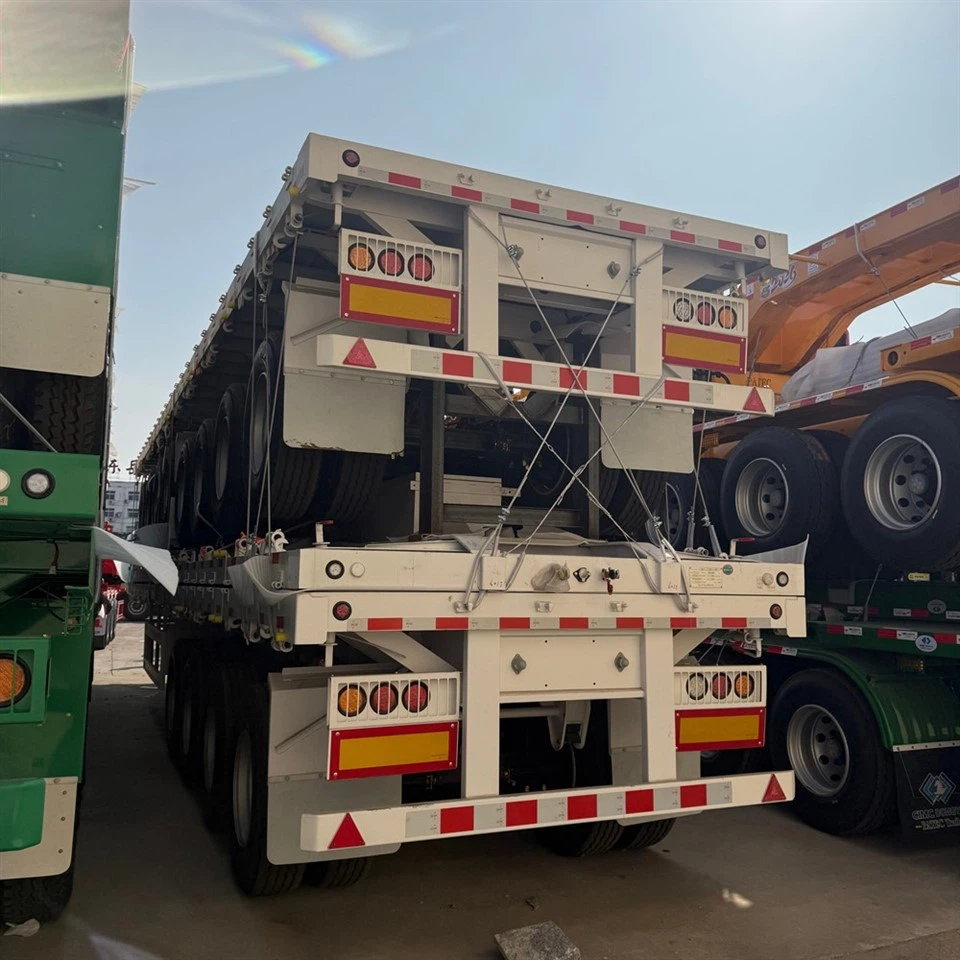
We offer a variety of lowbed semi - trailers, such as the Gooseneck Lowbed Trailer, Container Flatbed Semi Trailer, and Transport Semi Trailer. Each type has its own characteristics, and the center of gravity can affect them differently.
For a gooseneck lowbed trailer, the gooseneck design allows for better weight distribution towards the front of the trailer. However, if the center of gravity of the load is too far back, it can still cause instability.
A container flatbed semi - trailer is often used to transport standard shipping containers. The containers are usually quite heavy, and proper weight distribution is essential. If the center of gravity is off, it can lead to uneven tire wear and handling issues.
A transport semi - trailer is used for a wide range of loads. Whether it's construction equipment or industrial goods, getting the center of gravity right is crucial for safe transportation.
Tips for Adjusting the Center of Gravity
Once you've measured the center of gravity and found that it's not in the ideal position, here are some tips to adjust it:
- Reposition the load: Move heavy items towards the center of the trailer or towards the axles. For example, if the center of gravity is too far forward, move some of the front - loaded items to the rear.
- Use blocking and bracing: Secure the load with blocking and bracing materials to prevent it from shifting during transit. This helps maintain the desired center of gravity.
- Consider the order of loading: When loading multiple items, plan the order carefully. Place heavier items first and distribute them evenly.
Conclusion
Measuring the center of gravity of a load on a lowbed semi - trailer is a vital part of safe and efficient transportation. By using the methods I've discussed, you can ensure that your load is properly balanced and reduce the risk of accidents.
If you're in the market for a high - quality lowbed semi - trailer, we're here to help. Our trailers are designed to handle a variety of loads and provide excellent stability. Whether you need a gooseneck lowbed trailer, a container flatbed semi - trailer, or a transport semi - trailer, we've got you covered. Feel free to reach out to us for more information and to discuss your specific needs. We're always happy to assist you in finding the perfect trailer for your business.
References
- "Transportation Engineering Handbook"
- "Load Securement Guidelines"