
What is the minimum turning circle of a lowbed semi - trailer?
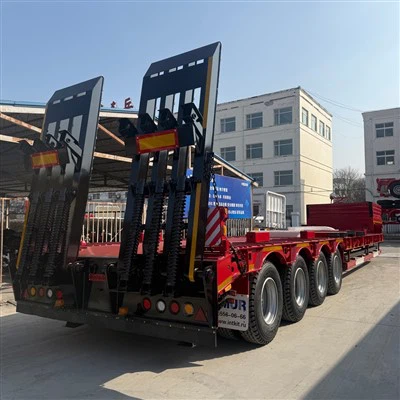
As a provider of lowbed semi - trailers, I've encountered numerous inquiries from clients about the minimum turning circle of these specialized trailers. Understanding this aspect is crucial as it directly impacts the trailer's maneuverability, which is vital in various transportation scenarios.
The Concept of Minimum Turning Circle
The minimum turning circle refers to the smallest circular path that a vehicle, in this case, a lowbed semi - trailer, can make while turning. It is typically measured as the diameter of the circle described by the outermost point of the vehicle's body during a full - lock turn. This measurement is significant because it determines where the trailer can be safely and efficiently operated. For instance, in tight construction sites, narrow city streets, or congested loading docks, a trailer with a smaller turning circle will have a distinct advantage.
Factors Affecting the Minimum Turning Circle of a Lowbed Semi - Trailer
- Trailer Length: One of the most significant factors is the length of the lowbed semi - trailer. Longer trailers generally have larger turning circles. This is because the rear end of the trailer has to follow a wider arc as the tractor unit turns. For example, a standard 40 - foot lowbed semi - trailer will have a larger turning circle compared to a 20 - foot one. The extra length means that more space is required for the trailer to complete a turn without hitting obstacles.
- Axle Configuration: The number and arrangement of axles also play a crucial role. Trailers with more axles tend to have larger turning circles. A multi - axle lowbed semi - trailer, such as a six - axle model, has a more complex steering geometry. The additional axles need to be coordinated during a turn, and the overall weight distribution across these axles affects how the trailer responds to steering inputs. In contrast, a two - axle lowbed semi - trailer may have a relatively smaller turning circle as there are fewer axles to manage.
- Steering System: The type of steering system on the lowbed semi - trailer can greatly influence its turning circle. Some trailers are equipped with a hydraulic steering system, which allows for more precise and flexible turning. This system can adjust the angle of the axles independently, enabling the trailer to make tighter turns. On the other hand, trailers with a fixed - axle steering setup may have a larger turning circle as the axles are less adaptable during a turn.
- Tractor - Trailer Coupling: The design of the coupling between the tractor and the lowbed semi - trailer is another factor. A well - designed coupling allows for a greater range of movement between the two units. If the coupling restricts the angle at which the trailer can turn relative to the tractor, it will increase the turning circle. For example, a fifth - wheel coupling that provides a wide articulation angle will enable the trailer to make sharper turns.
Typical Minimum Turning Circle Values
The minimum turning circle of a lowbed semi - trailer can vary widely depending on the factors mentioned above. In general, for a standard 20 - foot lowbed semi - trailer with a simple two - axle configuration and a basic steering system, the minimum turning circle diameter can range from 12 to 15 meters. For a 40 - foot lowbed semi - trailer with a multi - axle setup, the turning circle diameter can be anywhere from 18 to 25 meters. However, these are just rough estimates, and the actual values can be different based on the specific design and features of the trailer.
Importance in Different Applications
- Construction Sites: In construction sites, space is often limited, and there are numerous obstacles such as equipment, building materials, and workers. A lowbed semi - trailer with a small turning circle can navigate these tight spaces more easily. It can access different areas of the site to deliver heavy machinery or construction materials without causing disruptions. For example, a trailer with a small turning circle can quickly move around a corner to reach a specific construction area, reducing the time and effort required for transportation.
- Urban Transportation: In urban areas, roads are often narrow, and there are many intersections and traffic restrictions. A lowbed semi - trailer with a small turning circle can make it easier to navigate through city streets. It can make U - turns and negotiate sharp corners more efficiently, which is essential for timely deliveries. For instance, when delivering large containers to a city - center warehouse, a trailer with a good turning radius can avoid getting stuck in traffic and complete the delivery on time.
- Port Operations: At ports, there are a large number of trailers and other vehicles moving around. A lowbed semi - trailer with a small turning circle can maneuver in the congested port areas. It can quickly load and unload cargo, and move between different storage areas. For example, when transporting containers from the ship to the storage yard, a trailer with a small turning circle can make the necessary turns in the limited space available at the port.
Our Lowbed Semi - Trailers and Turning Circle
At our company, we understand the importance of a small turning circle for our clients. We offer a range of lowbed semi - trailers with different lengths and axle configurations. Our engineers work hard to optimize the design of the trailers to reduce the turning circle as much as possible. For example, we use advanced hydraulic steering systems in some of our trailers to improve their maneuverability.
We also provide Transport Semi Trailer, Container Flatbed Semi Trailer, and Container Skeleton Semi Trailer models, each designed with specific applications in mind. Our transport semi - trailers are suitable for general cargo transportation, and we have optimized their turning circles to ensure they can operate efficiently in various road conditions. The container flatbed semi - trailers are designed for container transport, and their turning circles are carefully considered to meet the requirements of port and urban transportation. The container skeleton semi - trailers, which are mainly used for transporting empty containers, also have a good turning radius to facilitate quick and easy movement.


Contact Us for Your Lowbed Semi - Trailer Needs
If you are in the market for a lowbed semi - trailer and are concerned about the turning circle, we are here to help. Our team of experts can provide you with detailed information about the turning circle of our different trailer models. We can also offer advice on which trailer is best suited for your specific transportation needs. Whether you are involved in construction, urban transportation, or port operations, we have a solution for you. Contact us today to start a discussion about your requirements and explore how our lowbed semi - trailers can meet your needs.
References
- Smith, J. (2018). "Maneuverability of Heavy - Duty Trailers". Journal of Transportation Engineering.
- Johnson, A. (2020). "Design Considerations for Lowbed Semi - Trailers". International Journal of Vehicle Design.