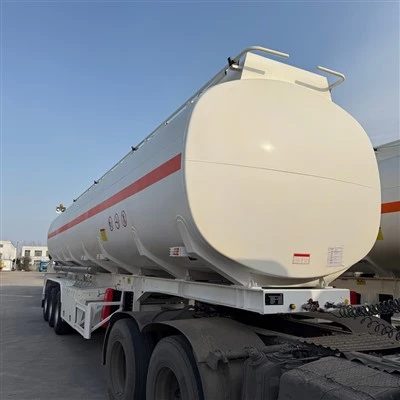

Hey there! As a supplier of tank semi - trailers, I've seen firsthand how crucial it is to accurately monitor the liquid level in these trailers. Whether you're transporting oil, LPG, or other liquids, having a reliable monitoring system is key to ensuring safety, efficiency, and compliance. In this blog, I'll share some of the best ways to monitor the liquid level in a tank semi - trailer.
Why is Liquid Level Monitoring Important?
Before we dive into the monitoring methods, let's quickly touch on why it's so important. First off, safety is a major concern. Overfilling a tank can lead to spills, which are not only bad for the environment but can also cause serious safety hazards. On the other hand, under - filling might mean lost revenue if you're not maximizing the trailer's capacity.
Moreover, accurate level monitoring helps with inventory management. You can keep track of how much product you're transporting and delivering, which is essential for accounting and supply chain management.
Different Types of Tank Semi - Trailers
We offer a variety of tank semi - trailers, including Oil Tank Trailer, LPG Tank Trailer, and Tanker Semi - trailer. Each type of trailer has its own unique requirements when it comes to liquid level monitoring, but the basic principles remain the same.
Methods of Liquid Level Monitoring
Float - Type Gauges
Float - type gauges are one of the simplest and most common ways to monitor liquid levels. They work based on the principle of buoyancy. A float is placed inside the tank, and as the liquid level rises or falls, the float moves up or down. This movement is then translated into a reading on a gauge outside the tank.
The advantage of float - type gauges is that they're relatively inexpensive and easy to install. However, they do have some limitations. For example, they can be affected by the movement of the trailer, which might cause the float to move erratically and give inaccurate readings. Also, in some cases, the float can get stuck, leading to false readings.


Ultrasonic Level Sensors
Ultrasonic level sensors use sound waves to measure the distance between the sensor and the liquid surface. The sensor emits an ultrasonic pulse, and when the pulse hits the liquid surface, it bounces back to the sensor. By measuring the time it takes for the pulse to return, the sensor can calculate the distance and thus the liquid level.
One of the main benefits of ultrasonic sensors is that they're non - contact, which means they don't come into direct contact with the liquid. This makes them suitable for use with a wide range of liquids, including corrosive ones. They're also quite accurate and can provide real - time readings. However, they can be affected by factors such as temperature, humidity, and the presence of foam on the liquid surface.
Capacitance Level Sensors
Capacitance level sensors work by measuring the change in capacitance between two electrodes. When the liquid level changes, the dielectric constant between the electrodes changes, which in turn changes the capacitance. The sensor then converts this change in capacitance into a liquid level reading.
Capacitance sensors are highly accurate and can work with a variety of liquids, including conductive and non - conductive ones. They're also relatively easy to install and maintain. However, they can be affected by the presence of build - up on the electrodes, which can lead to inaccurate readings.
Pressure Transducers
Pressure transducers measure the pressure at the bottom of the tank. Since the pressure is directly related to the height of the liquid column above the transducer, the liquid level can be calculated. This method is particularly useful for measuring the level of liquids with a known density.
Pressure transducers are reliable and can provide continuous level measurements. They're also suitable for use in harsh environments. However, they need to be calibrated correctly to ensure accurate readings, and they can be affected by changes in temperature and pressure outside the tank.
Choosing the Right Monitoring System
When choosing a liquid level monitoring system for your tank semi - trailer, there are several factors to consider. First, think about the type of liquid you'll be transporting. Some monitoring methods are better suited for certain types of liquids than others. For example, if you're transporting a corrosive liquid, a non - contact sensor like an ultrasonic sensor might be a good choice.
You also need to consider the accuracy requirements. If you need very precise level measurements, a more advanced sensor like a capacitance sensor might be necessary. On the other hand, if you just need a general idea of the liquid level, a float - type gauge might be sufficient.
Cost is another important factor. Some monitoring systems are more expensive than others, so you need to balance your budget with your requirements. Additionally, consider the ease of installation and maintenance. A system that's difficult to install or maintain can lead to higher costs in the long run.
Installation and Maintenance
Once you've chosen the right monitoring system, proper installation is crucial. Make sure to follow the manufacturer's instructions carefully. If you're not confident in your installation skills, it's a good idea to hire a professional.
Regular maintenance is also essential to ensure the accuracy and reliability of the monitoring system. This might include cleaning the sensors, checking for any damage, and calibrating the system as needed.
Conclusion
Monitoring the liquid level in a tank semi - trailer is an important part of ensuring the safe and efficient transportation of liquids. By choosing the right monitoring system and following proper installation and maintenance procedures, you can avoid spills, manage your inventory effectively, and comply with regulations.
If you're in the market for a tank semi - trailer or need more information about liquid level monitoring systems, don't hesitate to get in touch. We're here to help you find the best solutions for your needs.
References
- Smith, J. (2020). Liquid Level Monitoring in Industrial Tanks. Journal of Industrial Engineering.
- Johnson, A. (2019). Advances in Tank Level Sensing Technologies. International Journal of Sensor Technology.